
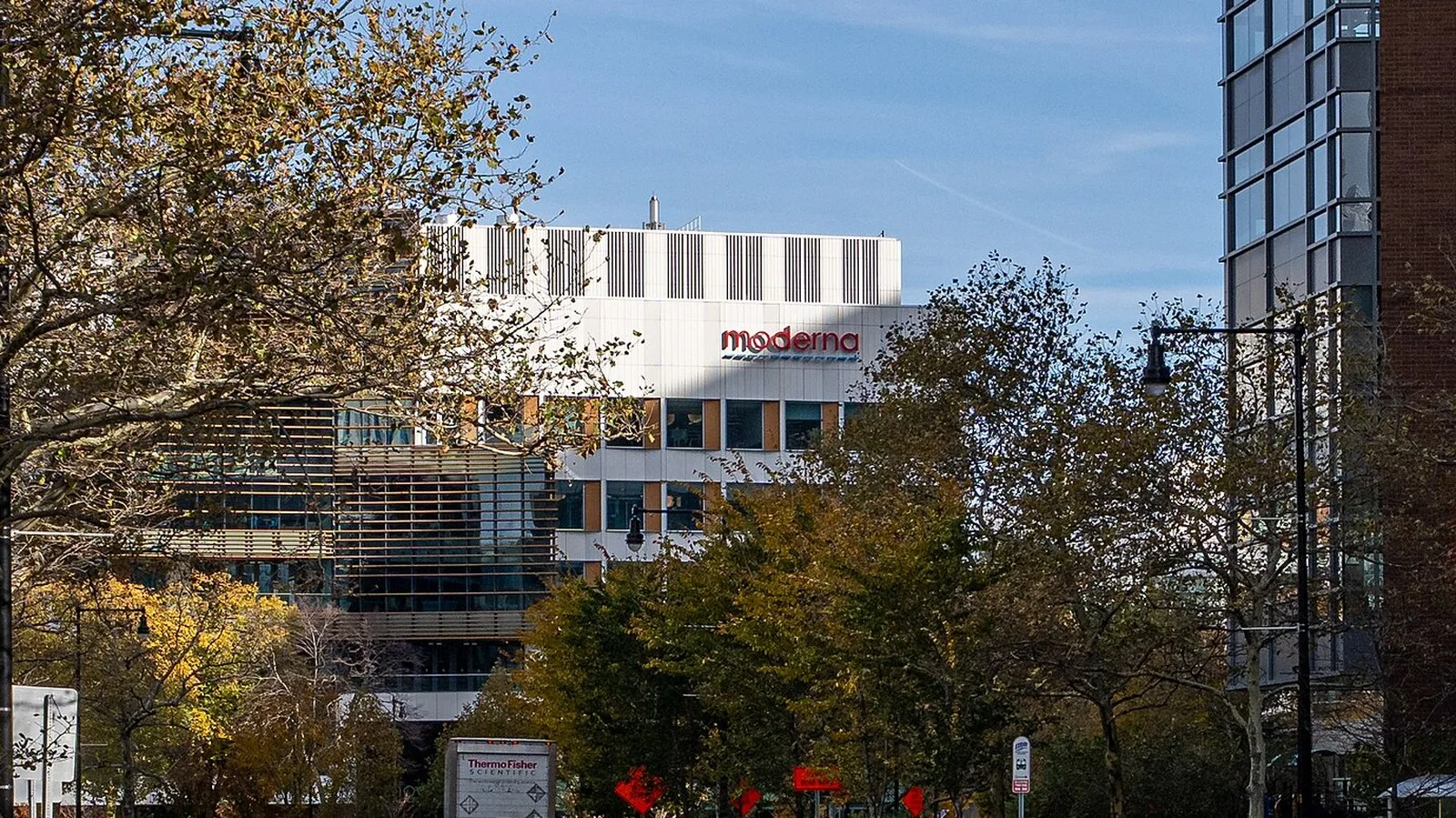
Moderna (NASDAQ: MRNA) closed at $174.38 on 19 August 2026, up $111.42 — a gain of 176.97% in a single session — after the company and Merck announced that their personalised mRNA cancer therapy had succeeded in a Phase 3 trial. The move added roughly $44.5 billion of market value in one day and made Moderna the S&P 500’s second-best performer of 2026, trailing only Sandisk.
It did not hold. As of 04:58 AM EDT on 20 August 2026, Moderna traded at $153.90 in the pre-market, down 11.74% — the stock is actively repricing as this is published, and the figures below are anchored to that quote.
The reason for the fade is sitting in the press release itself: Merck and Moderna did not disclose how well the drug actually worked.
What Merck and Moderna actually announced
On 19 August at 06:45 ET, Merck and Moderna reported positive topline results from INTerpath-001 (NCT05933577), a Phase 3 trial of intismeran autogene — previously known by the development codes mRNA-4157 and V940 — combined with Merck’s Keytruda (pembrolizumab).
The trial enrolled 1,137 patients with completely resected Stage IIB–IV cutaneous melanoma, randomised 2:1 to receive intismeran plus Keytruda or Keytruda alone. It met its primary endpoint of recurrence-free survival (RFS) and a key secondary endpoint of distant metastasis-free survival (DMFS).
This is the first positive Phase 3 readout for an individualised neoantigen therapy and for any mRNA-based cancer therapy. That is a real scientific milestone and it is not in dispute. What is in dispute is what it is worth.
The number that wasn’t there
Read the release carefully and something is missing. There is no hazard ratio, no confidence interval, no p-value and no absolute percentage attached to the Phase 3 result. There is no median follow-up figure and no adverse-event table. The entire efficacy disclosure is one phrase: “statistically significant and clinically meaningful improvements in RFS and DMFS compared to KEYTRUDA alone.”
This matters because a great deal of the coverage published on 19 August paired the announcement with a hard statistic — a 49% reduction in the risk of recurrence or death, hazard ratio 0.51. That figure is real, but it belongs to a different trial.
The hazard ratios of HR=0.51 (95% CI, 0.294–0.887) for RFS and HR=0.411 (95% CI, 0.200–0.843) for DMFS come from the five-year follow-up of the Phase 2b KEYNOTE-942/mRNA-4157-P201 trial, presented at ASCO on 1 June 2026 in a smaller, Stage III/IV-only population of 157 patients. They are quoted inside the 19 August release as background. They are not the Phase 3 result, and any analysis that treats them as such is reading a 2026 Phase 2b number into a Phase 3 announcement that deliberately withheld one.
Three further details are in the release and all three matter:
- The readout came at a pre-specified interim analysis, not a final one.
- Overall survival is immature. The trial continues in order to evaluate it, and its estimated primary completion date is October 2029.
- The full data will be presented at “an upcoming international medical meeting” that the companies have not named and not dated.
This matters more in melanoma than almost anywhere else. RFS and DMFS are surrogate endpoints, and adjuvant melanoma is littered with trials that moved them without ever demonstrating a statistically significant overall survival benefit. Bristol Myers Squibb’s CheckMate 238 improved recurrence-free survival and has repeatedly failed to show significant OS separation at successive follow-ups. Merck’s own KEYNOTE-054, which underpins Keytruda’s adjuvant label, has run for more than a decade without a reported OS benefit.
Until the hazard ratio is public, nobody outside Merck and Moderna can size the effect — and that includes every analyst who published a price target on 19 August. Citi said so explicitly, holding its Neutral rating and citing the undisclosed magnitude of the benefit.
The detail that halves everything: Merck owns half the drug
This is the most under-reported fact of the week, and it comes straight from Moderna’s own Form 10-Q filed with the SEC on 31 July 2026.
Merck and Moderna signed a collaboration and license agreement in June 2016, amended in 2018. Merck exercised its option on the programme in September 2022 and paid Moderna a $250 million option exercise fee in October 2022. Under that agreement, in the filing’s own words, the two companies collaborate on development and potential commercialisation “with costs and any profits or losses generally shared equally on a worldwide basis.”
Fifty-fifty. Moderna leads process development and manufacturing; Merck generally leads the clinical trials and is the registered sponsor of INTerpath-001.
Every peak sales figure quoted for intismeran must therefore be halved before it reaches Moderna’s income statement. Under ASC 808 the arrangement is not even booked as revenue today — Moderna records it as a net expense, $97 million in Q2 2026 alone.
What is the drug actually worth?
Several estimates circulated after the announcement. They are not comparable to one another, and stacking them into a single range is misleading — they differ in scope (all indications versus melanoma only) and in method (risk-adjusted versus not):
- BofA: $54 billion — explicitly unadjusted global peak sales, all indications, no probability discount applied. This drives its $170 objective.
- Morgan Stanley: more than $20 billion — risk-adjusted peak, all indications. The bank’s point is that this is already in the price.
- Morningstar: $16.8 billion by 2035, raised from $7.2 billion — all indications, and assuming a 100% probability of melanoma approval.
- Brookline Capital Markets: $4.67 billion by 2030 — all indications.
- Barclays: around $3 billion by 2035 — melanoma only, from a note predating the readout.
Halve any of them for Moderna’s share. On Barclays’ melanoma-only figure that is roughly $1.5 billion a year to Moderna, arriving in 2035.
For scale on the opportunity: the American Cancer Society and the NCI’s SEER programme both estimate 112,000 new US melanoma cases and 8,510 deaths in 2026. But SEER’s stage distribution shows 77% of melanoma is diagnosed localised and only 10% regional — and Keytruda’s existing US adjuvant label already covers Stage IIB, IIC and III following complete resection. The realistic label population is a subset of patients already receiving Keytruda, not a new market.
The manufacturing problem
Intismeran is not a conventional drug. Each dose is built for one patient: the resected tumour is sequenced, up to 34 neoantigens unique to that tumour are identified, and a bespoke mRNA is manufactured and shipped.
Moderna has made real progress on speed. Joe Margarones, the company’s head of digital individualized neoantigen therapy, told BioSpace in October 2025 that it now takes around six weeks from sample collection to administration, down from the 50 to 60 days the company quoted in 2019. Its purpose-built facility in Marlborough, Massachusetts began shipping patient batches in September 2025.
Two things Moderna has never disclosed: the cost per dose, and the capacity of that facility. The silence on capacity is conspicuous, because Moderna publishes capacity figures for its other plants — its Melbourne site is described as capable of up to 100 million doses annually. No second individualised-therapy site is planned, and Moderna’s own 10-K frames adding facilities as a risk (product comparability), not a roadmap.
Pricing is the other constraint. A 2026 analysis in Frontiers in Immunology put adjuvant pembrolizumab in resected Stage IIB/IIC at roughly $68,736 per quality-adjusted life year against thresholds of $100,000–$150,000. A bespoke add-on therapy must fit sequencing, bioinformatics, manufacture and cold chain inside the headroom that remains.
The business underneath
Whatever intismeran becomes, it is being bolted onto a company in steep decline. Moderna’s annual revenue has fallen from $19.26 billion in 2022 to $1.94 billion in 2025 — a 90% collapse as the COVID franchise unwound.
The quarter ended 30 June 2026 produced revenue of $145 million and a net loss of $782 million ($1.97 per share). Trailing twelve-month revenue is $2.23 billion against a net loss of $3.15 billion. Full-year 2026 guidance is not a dollar range at all — the company is “targeting up to 10% growth from 2025 revenue.”
Cash, equivalents and investments stood at $6.91 billion at 30 June. The balance sheet alone overstates it: Moderna paid a $950 million litigation settlement to Arbutus and Genevant in July 2026, leaving roughly $5.96 billion pro forma. A further $1.3 billion is contingently at risk on a Federal Circuit appeal, for which no accrual has been recorded. In July, Sanofi’s Translate Bio subsidiaries filed a fresh patent suit over the COVID and RSV vaccines. Moderna guides to year-end 2026 cash of $4.7–5.2 billion and says its resources are sufficient for at least twelve months, with $900 million undrawn on a term loan facility.
The pipeline record is mixed. The Phase 3 norovirus programme (mRNA-1403) did not meet its statistical criteria for early success at interim analysis. The seasonal flu vaccine fared better but took a bruising route: after an earlier Refusal-to-File letter and a February 2026 filing halt the FDA reversed within days, mRNA-1010 won a unanimous advisory committee vote in June and was approved as mFlusiva on 5 August 2026, taking Moderna to five approved products. Read that as regulatory volatility rather than scientific failure — but volatility is itself a risk when the next filing is the one that matters.
What Moderna’s own CEO has said about the US market
Speaking at Davos in January 2026, CEO Stéphane Bancel said Moderna would no longer invest in late-stage vaccine research trials, putting as many as 11 infectious-disease Phase 3 programmes in doubt. His reasoning was blunt:
“You cannot make a return on investment if you don’t have access to the U.S. market.”
Context cuts both ways here. When HHS wound down BARDA’s mRNA vaccine portfolio in August 2025 — cancelling 22 projects worth nearly $500 million, including a Moderna H5N1 award — the department stated explicitly that “other uses of mRNA technology within the department are not impacted.” Oncology was carved out, and Moderna has said it intends to continue its oncology and rare-disease programmes. It is also worth stating plainly that no US state has enacted an mRNA vaccine ban: bills in Montana, Idaho, Texas and Florida were rejected, left pending or died without a vote.
The residual risk is narrower but real. Cancer vaccines are regulated by CBER, the same FDA centre that reviews preventive mRNA vaccines. There is no structural firewall between the two.
Will Moderna raise equity?
A 177% move is a textbook window for an offering. As of the morning of 20 August — roughly 26 hours after the close — Moderna had filed nothing. A check of SEC EDGAR’s daily indexes for 18 and 19 August, covering 4,433 filings on the 19th alone, returns no Moderna entries. Merck filed nothing either; neither partner lodged an 8-K for a $44 billion move. There is no active at-the-market programme in Moderna’s filings, and its last automatic shelf registration was filed on 5 May 2023, which under Rule 415(a)(5) would have lapsed around May 2026.
That is not a barrier. Moderna qualifies as a well-known seasoned issuer and could file a new automatic shelf that becomes effective immediately and price a deal the same day. The finding is simply that it had not yet done so. Watch EDGAR, not the tape.
MRNA stock prediction: the bull case at $170
The most constructive published view belongs to BofA’s Alec Stranahan, who upgraded Moderna from Underperform to Neutral and lifted his objective from $40 to $170, calling the result a “watershed moment” that “fundamentally changed” Moderna’s post-COVID story. Morningstar more than doubled its fair value estimate to $163 from $79, raised its assumed probability of melanoma approval to 100%, and projected a launch in the first half of 2027.
Against the $153.90 pre-market anchor, BofA’s $170 implies roughly 10% upside.
The bull argument runs: intismeran validates an entirely new therapeutic class; the INTerpath programme already spans nine Phase 2 and Phase 3 trials across melanoma, non-small cell lung, bladder and renal cancer; a platform that works in one tumour type plausibly works in others; and the combination holds Breakthrough Therapy designation from the FDA (February 2023) and PRIME designation from the EMA (April 2023). Note the EMA designation covers Stage III/IV only — narrower than the trial’s IIB–IV population.
Note also what the bull case is not. $170 sits below the $174.38 close. The single most bullish target on Wall Street was already beneath where the stock finished on 19 August.
MRNA stock prediction: the bear case at $60
Here is the sharpest number in the entire story. Citi’s post-announcement target is $60 — and Moderna closed at $62.96 on 18 August, the day before the news broke. A firm that revised its target after reading the Phase 3 win still lands 4.7% below where the stock traded before anyone knew about it. Against the $153.90 anchor, $60 implies roughly 61% downside. JPMorgan’s Jessica Fye reiterated a Sell at $40.
The bear argument is straightforward. The efficacy data is unpublished. Overall survival is immature and years away, in a disease setting where surrogate endpoints have a poor record of converting. The revenue is split 50/50 with a partner. Manufacturing is bespoke, capacity is undisclosed and reimbursement headroom is thin. The base business is losing roughly $780 million a quarter on $145 million of revenue.
Regulatory timing is genuinely unclear, and the three available data points conflict. CNN reported on 19 August that the companies aim to file “within months.” BioSpace reported in October 2025 that the FDA had discouraged Moderna from seeking accelerated approval and that the company was targeting a submission for full authorisation by 2028. Morningstar projects a launch in H1 2027. These have not been reconciled by either company.
There is one more market pricing this, and it is not the equity market. Polymarket currently has FDA approval of a skin cancer vaccine at 28%, and a BLA even being submitted at 22%. Those are real dollars on a roughly one-in-four chance that this becomes an approved product — priced on the same day the equity market repriced Moderna by 177%. The two markets are looking at identical information and reaching conclusions that cannot both be right. A prediction market that will not pay out until the FDA acts has no squeeze mechanics, no index-inclusion flow and no options gamma pushing it around; it is the cleanest read available on the probability the equity move is implicitly assuming.
Where this leaves the stock
The defining fact of this rally is that Wall Street did not follow it up. Revised targets after the announcement ranged from Citi’s $60 to BofA’s $170. Vendor consensus sits far lower: $78.78 across 23 analysts at StockAnalysis, $74.54 at TipRanks, $56.56 at MarketBeat. Against the $153.90 anchor, consensus implies roughly 49% downside.
Ratings tell the same story, and it is worth being precise about it: not one analyst moved to Buy. BofA upgraded to Neutral; William Blair upgraded to Outperform. Goldman Sachs, Morgan Stanley, RBC and Citi all raised their targets while holding their ratings. Four firms marked up the number and left the recommendation alone.
The mechanics deserve a mention, with a caveat. Moderna had 49.77 million shares sold short as of the 31 July 2026 settlement date — 12.47% of shares outstanding, at 7.21 days to cover. That reading is nineteen days older than the event and cannot reflect any covering that happened on 19 August; short interest was in fact falling into the announcement, from 53.19 million at the end of June. Several analysts attributed part of the move to a squeeze, and that is a reasonable inference, but the settlement data to confirm it does not exist yet. Separately, Fintel recorded 41,997,256 shares of off-exchange short volume on 19 August, a 47.60% short-volume ratio — that is daily trading flow including market-maker activity, not short interest.
A useful control is Merck. The same news lifted MRK to a $152.20 close, up 12.60%, near its 52-week high of $153.50. That is the market’s read on the science, undiluted by squeeze mechanics or single-asset concentration. Moderna moved fourteen times as far.
The science is real, the milestone is genuine, and the price ran ahead of what can currently be underwritten. Giving back nearly 12% within hours is consistent with that. Two dates now matter: the unnamed medical meeting where the hazard ratio finally becomes public, and any new shelf registration appearing on EDGAR. For comparable single-catalyst repricings, see our coverage of Novo Nordisk (NVO), Boston Scientific (BSX) and AAOI.
Until that first date arrives, every price target on Moderna — bullish or bearish — rests on a number nobody outside Merck and Moderna has seen.
This article is for informational purposes only and does not constitute investment advice. Figures are sourced from company press releases, SEC filings, ClinicalTrials.gov, SEER and named analyst reports, and are anchored to a pre-market quote of $153.90 at 04:58 AM EDT on 20 August 2026. The stock was actively repricing at the time of writing; verify current data before making any investment decision.